

















Surgical Blades: Precision Tools that Save Lives
A surgical blade is a sharp, precision-cutting tool used by surgeons to make incisions during medical procedures.
Introduction
In surgery, being precise is incredibly important. No matter how small, every cut needs a tool thats not just sharp, but perfectly right for the job. The surgical blade, often called a scalpel blade or surgeon blade, is the essential tool that makes these important actions possible. For anesthesiologists, surgeons, hospital procurement specialists, and medical students, a deep understanding of these foundational tools is not just beneficial, but essential. This comprehensive guide will discuss the distinct characteristics, advantages, and optimal applications of the two primary materials used in modern surgical blades: stainless steel and carbon steel.
What is a Surgical Blade?
The surgical blade is a tool that plays a vital role, whether it is a small incision or a major operation. This tiny tool is of huge importance to a surgeon. A sharp, sterile, and well-manufactured blade provides a clean cut along the tissue with the least possible damage so that the patient can recover fast.
Types of surgical blades
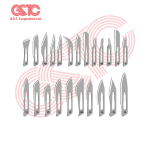
There are various types of surgical blades suited to every surgical requirement. The following are the common types:
1. Blade no. 10
Shape: The blade has a curved cutting edge.
Use: Mostly general surgery; usually used for making large incisions through skin and muscle.
2. Blade no. 11
Shape: A pointed-tipped straight blade.
Use: Delicate punctures, removing stitches, and making stab incisions.
3. Blade No. 12
Shape: Curved with a sharp edge.
Use: ENT surgeries and procedures in narrow spaces.
4. Blade No. 15
Shape: Small, curved cutting edge.
Use: For small, precise cuts in thin, delicate areas like pediatrics and plastic surgery.
Comprehensive Applications of Surgical Blades
1. General Surgery
-
Large incisions (i.e., abdominal surgeries)
-
Routine surgeries like appendectomies or hernia repairs
-
The preferred blades are n 10, 20, and 22.
2. Cardiovascular & Thoracic Surgery
-
Precise incisions around arteries, veins, and delicate tissues
-
Minimal trauma is required for clotting and healing to occur.
-
The preferred blades are n 11, 15.
3. Orthopedic Surgery
-
Cut thick tissues, ligaments (connect bones to other bones), and cartilage (cushions bones at joints).
-
Blades are used for joint replacement or fracture-repair purposes.
-
The preferred blades are no. 21, 22.
4. Plastic & Cosmetic Surgery
-
Clean aesthetic cuts with minimal scarring.
-
Used in facelifts, mole removals.
-
The preferred blades are n 15, 12.
5. ENT & Ophthalmic Surgery
-
Micro-level incisions are required around the ears, nose, and eyes.
-
High-precision blades for internal access.
-
The preferred blades are no. 11, 12.
6. Dermatology
-
Skin biopsies and mole excisions, laser preparation.
-
Useful in cutting thin skin layers.
-
The preferred blades are n 15, 10.
7. Gynecology & Obstetrics
-
C-sections, uterine surgeries, and sterilizations.
-
Used in clean soft tissue incisions.
-
The preferred blades are n 20, 22.
8. Dental Surgery
-
Gum and root access, surgical extractions.
-
The preferred blades are n 11, 12, and 15.
9. Animal surgeries
-
Animal surgeries, including soft tissue and orthopedic surgery.
-
The preferred blades are the same types used in human surgery, depending on the size of the animal.
10. Pathology & Lab Dissection
-
Sample collection, dissection, and anatomical studies.
-
Widely used in medical colleges and forensic labs.
Usages of Surgical Blades
Medical procedures conducted in various fields heavily rely on surgical blades. These fine tools are necessary for making correct incisions, thereby enabling surgeons to safely and efficiently access the internal organs, tissues of the body. The surgical blade is designed to make clean cuts and thereby reduce tissue trauma, healing time, and improve surgical recovery.
1. General Surgery
In general surgery, surgical blades are used to make very first incisions into the skin before dissecting down through tissues. Depending on the type of procedure, scalpel blades are selected based on their size and shape of it to meet specific cutting demands. Each surgeon blades sharpness and sterility guarantee precision and decreased possibility of infection.
2. Orthopedic Procedures
By orthopedic procedure, surgical blades are used to cut open all soft tissue, including skin, muscles, and cartilage, in procedures like joint replacement or fracture repair. At such procedures, the precision with which this surgical blade behaves is most important, so adjoining structures are not damaged.
3. Cardiovascular and Thoracic Surgery
In incisions for heart and lung surgeries where every precision counts, scalpels and blades enable surgeons to dissect delicate tissues around vital structures. The highest quality surgeon blades give sharp and clean lines that matter for safety and recovery.
Conclusion
Whether performing minor outpatient procedures or surgeries that save lives, surgical blades are significantly important to individual surgical precision, safety, and successful clinical outcomes. As such, the importance of good-quality surgical blades cannot be overstated, whether for a healthcare provider, surgeon, hospital administrator, or medical equipment distributor. The quality, consistency, and compliance with international standards are guaranteed if they are sourced from a reputed manufacturer of GST Corporation, one of Indias largest medical equipment exporters.